Local SNP encoding
Shared 1D-CNN layers encode ordered SNP regions using genotype dosage, heterozygosity, call masks and positional information.
MAIZE · DROUGHT RESPONSE · GENOMIC PREDICTION
Explore a model that brings local SNP patterns, biological annotation and genome-wide relationships together to support research on maize breeding.
THE MODEL
BioGNet predicts drought-related phenotypes using a shared SNP encoder, biological attention and a single genomic relationship branch. The outputs are predicted trait values.
Shared 1D-CNN layers encode ordered SNP regions using genotype dosage, heterozygosity, call masks and positional information.
Two attention blocks connect regions with LD, distance and annotation priors. Six functional slots and two background slots summarize regional information.
A single 64-dimensional GRM input and material-type embedding join the regional representations before phenotype regression.
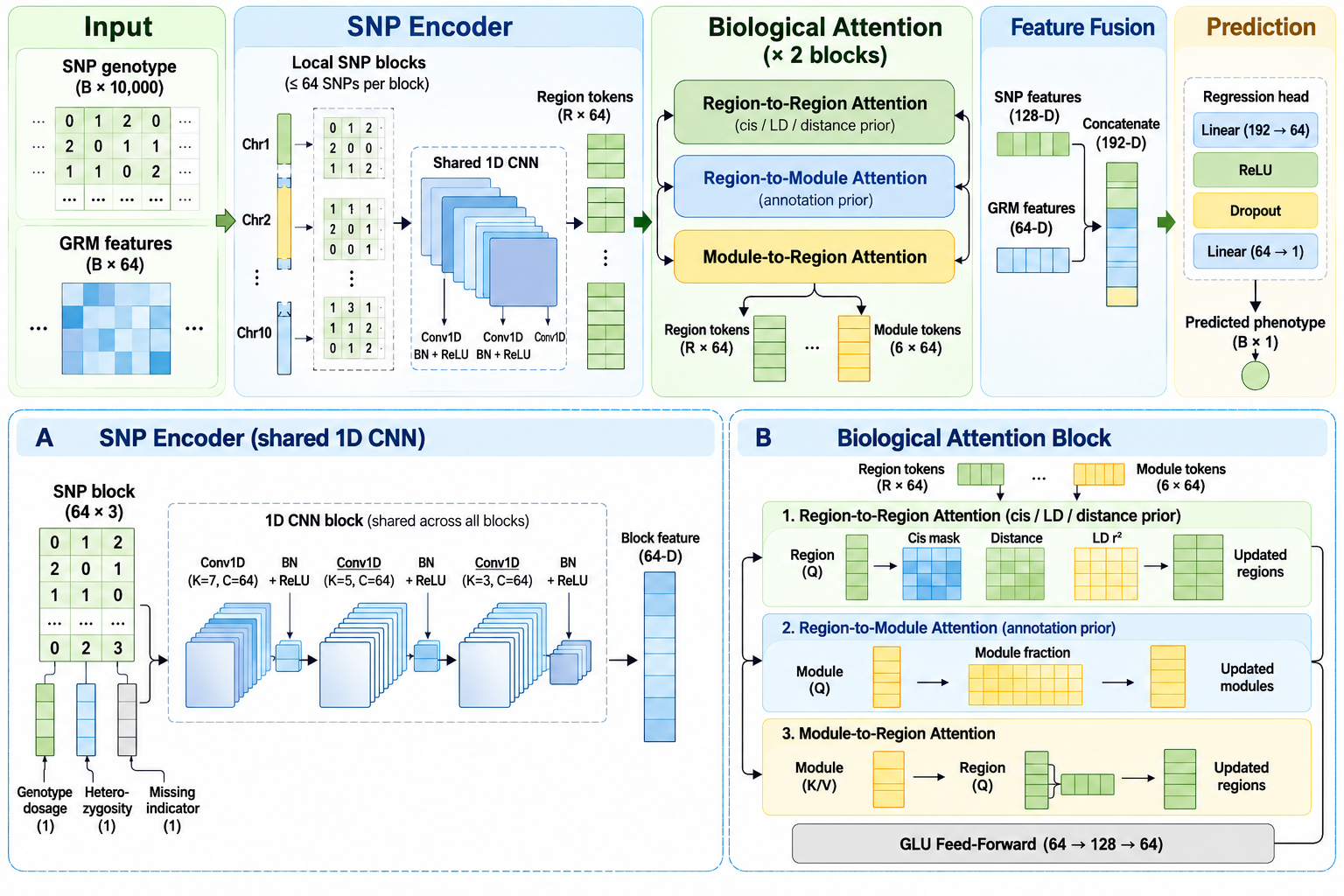
WW and WS denote well-watered and drought-stress tasks. D is one composite endpoint built using a frozen historical transformation. The eight attention slots are distinct from the single GRM branch.
HELD-OUT BENCHMARK
Explore 13 models across seven tasks. Choose a material cohort and metric to inspect the archived test results.
These archived comparisons use the same frozen predictions as the manuscript. BioGNet uses a single seed selected post hoc by test Pearson r; three-seed mean results are a separate evaluation. R² is 1 − SSE/SST and can be negative. Pooled results include differences between material types.
PREPARE YOUR DATA
Submit one ZIP using the documented CSV/TSV structure. Basic file checks run at submission; full genotype alignment and scientific compatibility are reviewed by the team.
Include genotypes.csv, markers.tsv, samples.tsv and README.md. The example uses synthetic materials and a few example markers.
Identify F1 hybrids or inbred lines. Preserve mother and father direction for hybrids. Use AGPv4 positions and explicit REF/ALT alleles.
Prediction only requires compatible genotypes and metadata. Evaluation also needs observed phenotypes. Evaluating observed D requires the three traits paired under WW and WS within the same environment.
Use ALT hard-call dosages 0, 1 and 2; missing calls are NA, blank or dot. Markers and alleles must be aligned to the relevant frozen task panel and training-reference GRM before inference. The template demonstrates format and is not an inference-ready dataset.
Use your reference ID and submission email to check the review status. You can also record a deletion request for the team.
BioGNet studies genomic prediction of maize drought-related traits using four years of historical phenotyping. Model attribution and candidate-gene annotations provide research leads rather than experimental proof of variant function.
Predictions, rankings and any validation metrics depend on input compatibility and the target genetic background. Metrics require observed phenotypes and are not generated for genotype-only submissions.